

Note: This article is free of AI editing.

F1 as I know It
I’ve been seeing and hearing a great deal about Formula one Racing as of late and I must admit it’s been catching my interest. I was a spectator at best having watched F1 with Brad Pitt and Damson Idris; a film that brought back the excitement I had when visiting Monaco in the South of France as the Tour Bus Driver pointed out the racing stripes on the side of the rode. How exciting to know I was driving on the race course of the Monaco Grand Prix. I loved the game as a kid, Super Monaco Grand Prix. So when we arrived in front of the Casino Royale with exotic cars parked out front and getting wanded by security just as James Bond did, I knew I was in a special place.
Inspiration
I watched a Facebook reel this Saturday of Lewis Hamilton getting interviewed by everyone’s favorite Astrophysicist, Neil deGrasse Tyson, and my interest was sparked when Lewis mentioned all the technology that went into Formula One Racing. Apparently track time is highly limited so Racing Teams rely on Simulator’s for daily training and strategy development. When he mentioned he was 0.4 seconds behind on a straightaway but it was the fault of the computer, that’s when my ears pinned up and I knew he was talking about latency or time delay based on a number of reasons.
1) Hops 2) Node Congestion 3) Hardware limitations 4) Lack of instance failover, replicas.
Then I saw another reel mentioning that the entire pit crews on racing teams are former athletes. Hey! I’m a former athlete. I can’t run a 4.78 40 yd. dash anymore like I use to when I played football but it’s nice to know I’d be a part of a culture that I know and love.
Architecture
Then I got to thinking about how everything’s setup. The best place to start is with the high profile HPC stack the Pro’s use. Right off the bat I found out they’re highly CPU limited by how much hardware they can use as mandated by the FIA’s Aerodynamic Testing Restrictions (ATR). For AWS, they use Elastic Fabric Adapter, allowing nodes to communicate with one another as opposed to relying solely on main and parallel multi-threading of the OS. Assetto Corsa for the simulator or in my case on a budget. LFS. A Kubernetes cluster of Docker images (or CRIO w/o) running inside of high performance VM’s, each with Active / Passive failover. Again, I need to read up on the FIA’s Aerodynamic Testing Restrictions to see the limits I’d have. Then there’s HPC schedulers (Slurm, PBS, LSF) which I still need to delve into as well as the file systems (Lustre, GPFS, BeeGFS) and GPU computing (CUDA, ROCm/HIP).
AI
Then there’s AI models. You always need a driver to test out the strategies on the track; turn 1’s optimal speed is 60 km/hr, turn 2 is 53 km/hr., etc. You have to know the limits of the vehicle to where it loses control on a turn going 58/km/hr, but 57 km/hr. with 25 psi in the rear, 28 in the front tires. I’d modify Sokoban to either A* or IDA*, with and without the competing cars. Car A (Team Driver) no cars at turn, Car B Right at turn, Car B Left at turn, etc. I’d run that simulation a few million times so I could tell Liam Lawson or Arvid Lindblad, “If no cars around turn 1, go 60. Car to your left, drop to 55. Car to your right no more than 58 unless you want to run the competition off the track.” Ultimately, I’d use the average speeds of the winners over the past 5 years as a baseline and go from there. Tire pressure would be the unknown but we could predict based on straightaway speeds. Instead of definitive tire psi, I’d use percentages where 30 psi for Lewis’ car would represent 100% psi. Since the cars are all different, % is the best approach.
Conclusion
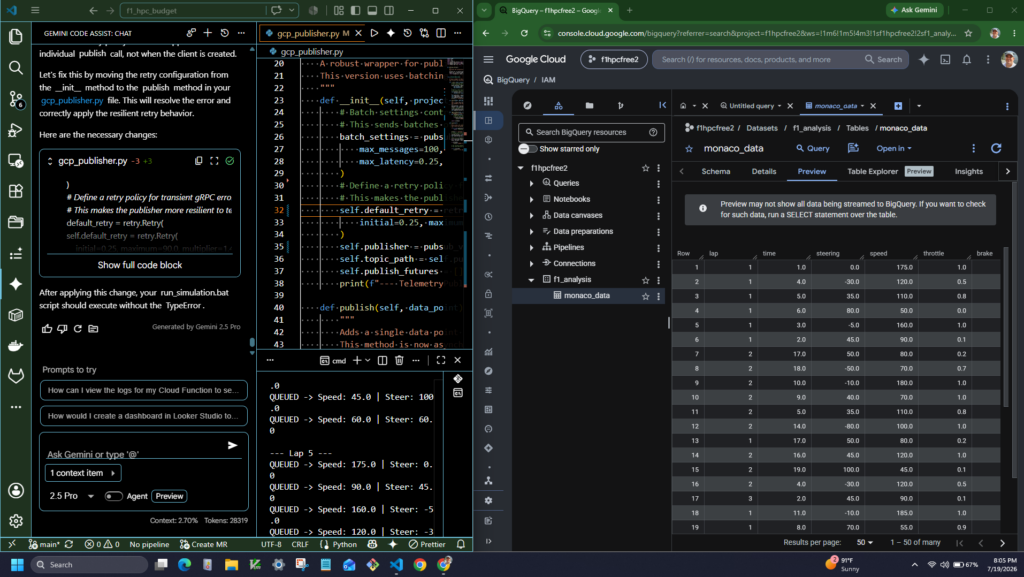
In conclusion, I love that there’s a sport out there that uses DevOps as a key component of their strategy to win. I look forward to continue working the F1 stack and building up my skills in the sport. For now, I’ll have to settle for my GCP setup using Big Query, Pub/Sub and Cloud Run Functions to collect data w/ LFS simulator.